https://www.youtube.com/watch?v=Imv2BpJzydg
Powerful and unique
Neural Simulation to Verify Brain-like AI Concepts
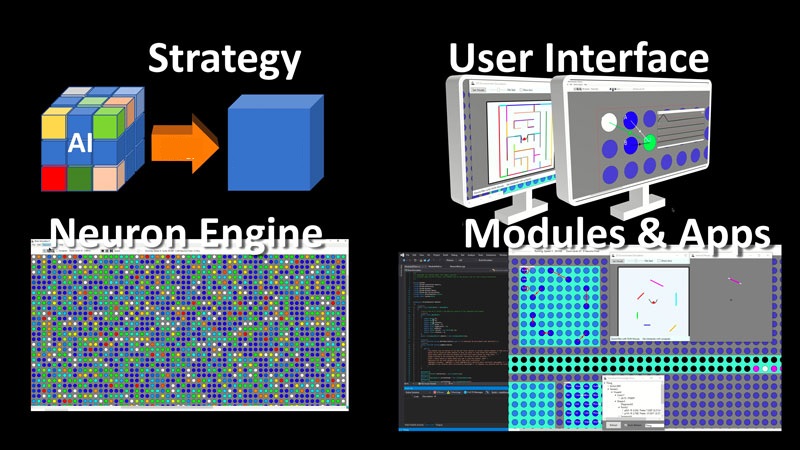
Brain Simulator II has tested and verified that the Atomic Thoughts behind Brain Simulator Thought can be implemented using neurons.
It is a working, open-source system for building and experimenting with networks of spiking neurons and synapses.
Easy user interface
A graphical neuron and module display which allows users to explore / modify the network’s internal working in real time.
Spiking neuron engine
Process up to 2.5 billion synapses per second on a desktop computer. Networks can be distributed across multiple servers.
Modules and applications
Program the neuron engine to demonstrate vision, mobility, internal modeling, language, and planning.
Fully Featured
Includes simulators and robotic control modules. Also includes the software interfaces so you can write your own modules.
Ideal Use-Cases
Can structured knowledge be implemented using neurons?
Brain Simulator II is designed to explore this directly.
It tests whether:
- concepts can be represented by neural assemblies
- relationships can be encoded through connections
- structured knowledge can emerge from local interactions
The same structures used in Brain Simulator Thought can be represented in neural form.
- concepts → neural assemblies
- relationships → connection patterns
- statements → linked structures
This shows that structured knowledge does not require a separate symbolic system—it can exist within neural networks.
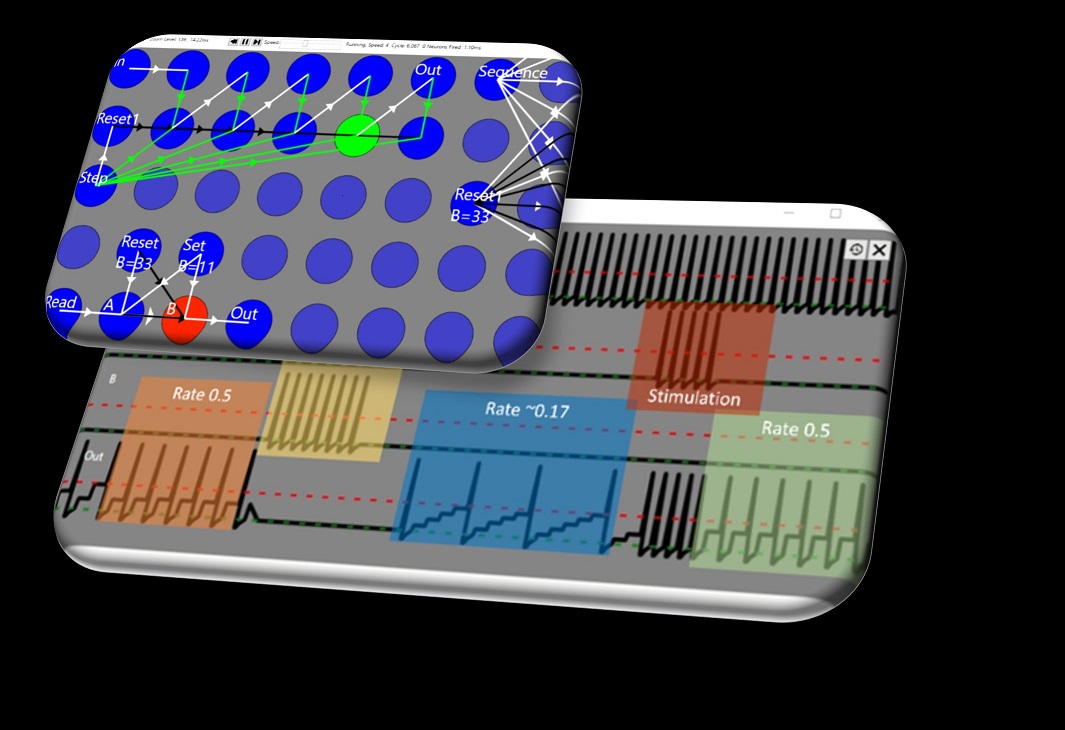
These experiments demonstrate that structured knowledge is compatible with neural systems.
- complex representations emerge from simple elements
- learning occurs through local changes
- no global control or backpropagation is required
Brain Simulator II provides experimental support for the architecture used in Brain Simulator Thought.