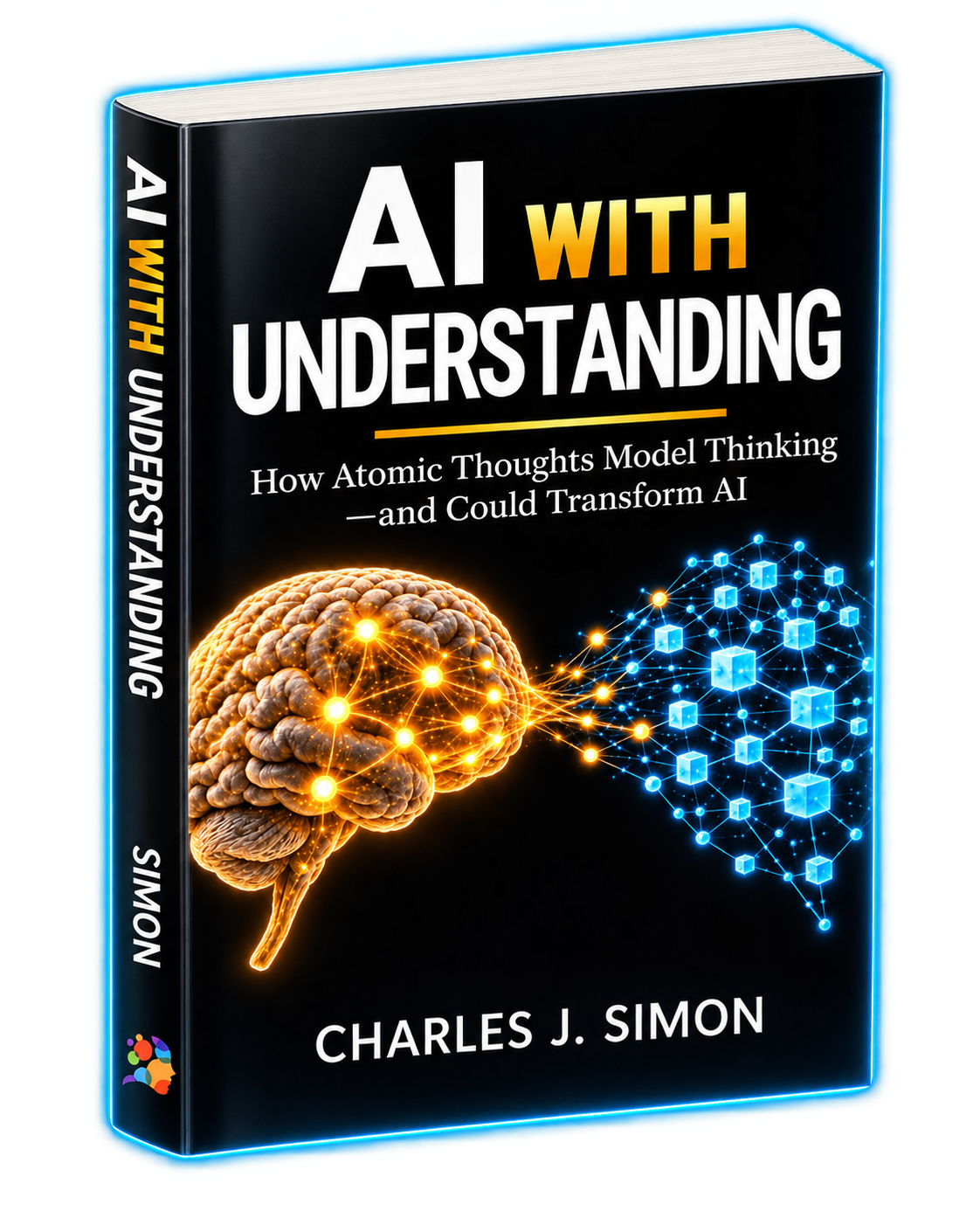
AI WITH UNDERSTANDING
How Atomic Thoughts Model Thinking
—and Could Transform AI
Charles J. Simon
Coming February 2027
Charles J. Simon
Coming February 2027
Today’s AI can do remarkable things, but brains can still do many things AI can’t. How does the brain do them—and can we bring those ideas into AI?
In AI With Understanding, AI researcher Charles J. Simon explores this question through an unusual combination of neuroscience, cognitive architecture, and working software. The book includes free, interactive online Labs where readers can create knowledge, explore its structure in 3D, and experiment with learning, inheritance, and memory. No programming experience is needed.
Much of the journey is really about the human brain. How do you recognize a familiar object from incomplete information? Learn a new fact from a single experience? Recognize commonalities and organize things into classes? Use those classes to extend existing knowledge to new things, while remembering exceptions? Imagine situations that don’t exist, or carry out a learned mental procedure? Somehow your brain does all this with slow neurons, limited energy, and no central processor.
The book argues that a missing ingredient in today’s AI may be structure. Human minds do not merely process streams of information. They build persistent internal models connecting objects, attributes, relationships, actions, goals, sequences, memories, and imagined possibilities.
Simon develops a surprisingly simple possibility: these capabilities can be built from the same underlying cognitive building block—an Atomic Thought. Why atomic? Atomic Thoughts are simple, reusable structures that could plausibly be implemented in biological neural circuits. But, like physical atoms, their greater power comes from composition: the same basic components can be combined recursively to create structures of almost unlimited complexity.
This leads to a different way of looking at both brains and AI. Rather than treating recognition, knowledge, language, reasoning, memory, imagination, and learned procedures as separate problems, AI With Understanding explores how they might arise from a common architecture.
And the ideas aren’t merely theoretical. Beyond the online Labs, Simon’s open-source BrainSim Thought software implements many of the mechanisms discussed in the book, allowing researchers and developers to examine, test, and extend the architecture.
Written for curious readers interested in the future of intelligence, as well as AI researchers, software developers, neuroscientists, and cognitive scientists, AI With Understanding invites readers to explore a different possibility: that the path toward more capable AI begins by understanding how brains organize knowledge.

AI With Understanding develops the Atomic Thought model step by step, showing how one basic structure could support many of the capabilities we associate with human thinking.
spent decades exploring how the human brain works and how its principles might be applied to artificial intelligence. He developed Brain Simulator II and BrainSim Thought, open-source projects that investigate biologically plausible approaches to cognition. Simon holds a BS in Electrical Engineering and an MS in Computer Science. His career includes software development at Microsoft and neurological test instrumentation at Cadwell Laboratories. He is the founder of the Future AI Society.
Publications: https://futureaisociety.org/resources/publications-new/

Download the one-page book information sheet (PDF): HERE.
charles@futureaisociety.org

© 2023 Future AI Society., All rights reserved.